Why Your Wi-Fi Is Slow Even With a Fast Internet Plan
Learn why is my WiFi slow even with a fast internet plan and discover effective solutions to enhance your WiFi performance.
Fast plans don’t always mean fast results at home. Many performance drops trace to the local network link rather than the provider. Typical symptoms include buffering, lag in gaming, choppy video calls, and slow downloads. These signs often point at the router, placement, or device limits—not the plan itself.

Start with simple checks. Restart the modem and router, run a repeatable speed test, and try Ethernet for a key device. These quick wins often restore normal speed within minutes and help isolate the root cause.
Later sections show how to tell whether the provider, modem, router, or a single device causes the issue. You’ll get a step-by-step troubleshooting path: test first, then tackle congestion, placement, interference, cables, latency, and hardware upgrades. Make one change at a time so you can confirm what actually improves the connection.
Key Takeaways
- Many home slowdowns come from the local network, not the ISP.
- Restarting modem and router is the fastest diagnostic step.
- Run repeatable speed tests and use Ethernet for critical devices.
- Address placement, interference, and congestion before upgrading plans.
- Change settings one at a time to verify real improvements.
Fast internet speed vs slow Wi‑Fi: what “slow” really means at home
Fast plans on paper often meet a different story inside the house. A modem can show high throughput while devices feel unresponsive. That gap comes down to two simple factors.
Bandwidth (Mbps) vs latency (ping)
Bandwidth (measured in Mbps) controls how much data moves at once. It matters for 4K streaming and big downloads.
Latency (ping) controls how fast interactions feel. Low ping helps gaming and video calls stay smooth.
What Else Would You Like to Know?
Choose below:
Limits of advertised “up to” speeds
Providers and the isp often quote “up to” numbers. Real-world results vary with infrastructure, peak congestion, and home network loss.
- Wireless overhead, signal loss, or interference can reduce Wi‑Fi throughput despite strong Mbps at the modem.
- Upload vs download imbalance can hurt video calls and cloud backup even when streaming looks fine.
- Peak-time neighborhood congestion commonly lowers measured internet speeds.
Good means steady throughput plus low latency across the network. The fastest way to stop guessing: measure at the modem, at the router, and on the device.
Run the right speed tests to pinpoint where the slowdown starts
Begin by measuring actual speeds at different points to find the weakest link. A short, repeatable checklist separates provider faults from home network problems.
Check plan speeds and test across different times
Find the advertised plan speed in your ISP account or bill so you have a clear benchmark.
Run tests at several times during the day to spot peak-hour drops. Record download, upload, and latency for each run.
Test the modem with an Ethernet cable
Unplug the router from the modem. Connect a computer directly to the modem using an ethernet cable and run tests.
Security note: Direct-to-modem browsing removes router protections. Keep this step brief and only for testing.
Test the router — wired and wireless
Reconnect modem to router. Test a wired device on the router, then test Wi‑Fi from typical rooms.
If modem results match the plan but router numbers drop sharply, suspect router hardware, settings, placement, or the cable between devices.
How to read big gaps
- Modem good, router poor: check router firmware, cable quality, and interference.
- All tests low: log times and contact your ISP or provider with test data.
why is my wifi slow even when the modem speed looks fine?
When direct modem tests match your plan yet devices struggle, the bottleneck often lives inside the home network.
Wi‑Fi limitations come from the router, placement, and local interference — not the internet feed itself. The modem may hand off full throughput, but the router must manage traffic, radios, and multiple devices. Older hardware or poor placement can cut real-world performance sharply.
Signs the router may be the bottleneck
Look for random reboots, frequent disconnects, and inconsistent speeds room-to-room.
If the router runs hot or stops getting firmware updates, it often struggles with many simultaneous connections.
How to diagnose and capture useful data
- Confirm wired connections at the modem stay stable.
- Note which devices slow and which rooms lose signal.
- Record times, symptoms, and whether rebooting helps.
“A quick, controlled reboot of modem and router often reveals whether the problem is temporary or a hardware bottleneck.”
Start by unplugging power, wait 30 seconds, then plug the modem back first and allow it to settle before restarting the router.
Next steps: If problems persist, check congestion, dead zones, and interference — the most common in-home drivers of slowdowns.
Home network congestion from too many connected devices and bandwidth-heavy activities
A home network acts like a highway: too many simultaneous streams, calls, uploads, and downloads create a jam that slows every device’s connection.

How everyday activities add up
Multiple 4K streaming sessions, video calls, game downloads, and cloud backups all consume bandwidth at once.
Always-on smart home gadgets and background uploads quietly add to the load.
Use router QoS and prune unused devices
Open the router settings and enable QoS to prioritize work calls, gaming, or streaming. Prioritization gives key traffic a steady share of bandwidth.
Check the connected devices list or network map. Remove unknown or unused devices and consider rotating the Wi‑Fi password to block intruders.
Stagger heavy tasks and isolate guests
Schedule large downloads and backups for off-peak hours to avoid peak congestion.
Enable a guest network to cap guest bandwidth and improve security by isolating their devices from main systems.
“After pruning and QoS, households report smoother streaming and fewer lag spikes.”
| Action | Where to do it | Expected outcome |
|---|---|---|
| Enable QoS | Router settings > Traffic Management | Prioritized work calls and gaming, fewer interruptions |
| Audit connected devices | Router > Connected devices / Network map | Fewer unknown clients and freed bandwidth |
| Stagger downloads | Console/PC settings or scheduler | Reduced daytime congestion, better streaming speed |
| Set up guest network | Router > Guest network | Improved security and capped guest bandwidth |
Weak signal strength, dead zones, and poor router placement
A router tucked in a closet or at one end of the house can leave large areas with little usable signal.
How distance and materials cut range and speeds. As a device moves away from the router, signal strength drops. That forces retries and reduces real throughput.
Common building materials matter. Plaster, brick, tile, metal appliances, and mirrors block radio waves and create dead zones. Floors and stairwells also limit range.
Placement fixes that work
- Choose a central, elevated spot on an open shelf for best coverage.
- Keep the router away from large electronics and thick walls.
- Rotate antennas or angle them per device locations.
How to spot dead areas and decide next steps
Walk-test with a phone or laptop. Watch the signal bars and run a short speed test in key rooms.
If a few feet of relocation helps, stick with that. For multi-story or long layouts, add a mesh system, extender, or a wired access point.
Even with good placement, nearby interference and crowded channels can still harm speeds.
Wi‑Fi interference and channel congestion in busy neighborhoods
Dense neighborhoods and household electronics can turn airwaves into a noisy battlefield for your connection. That noise lowers real-world speeds even when signal bars look good.
The difference between a weak signal and interference: low signal means devices are far from the router. Interference means nearby radios make the channel noisy. You can see full bars yet suffer poor throughput because packets keep colliding.
Common interference sources at home
- Microwaves, cordless phones, and baby monitors that use the 2.4 GHz band.
- Bluetooth speakers, headphones, and many smart devices operating nearby.
- Neighboring routers and apartment networks that share the same channels.
Practical steps to reduce congestion
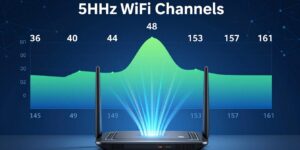
Switch compatible devices to 5 GHz for higher throughput and less crowding. Note: 5 GHz has shorter range, so it may not reach distant rooms.
- Separate SSIDs for 2.4 and 5 GHz so key devices stay on the faster band.
- Move the router away from TVs, soundbars, and kitchen appliances.
- If interference persists, consider a modern router with better radios or a mesh system for stable coverage.
“Switching bands and trimming local noise often yields the largest, easiest gains in home network performance.”
Loose or damaged cables between modem, router, and devices
A damaged connector or a loose lead can throttle an otherwise healthy home network. Physical links carry the full internet feed into your home, so a single bad run can cause major interruptions and sudden slowdowns.
Quick ethernet checks that prevent major dropouts
Inspect plugs: each ethernet plug should click firmly into the port. A loose fit or bent pins can cut throughput without warning.
Look for visible damage: no kinks, cuts, frayed jackets, or crushed sections along the cable length.
Coax and modem tips for cable internet homes
- Hand-tighten coax at the modem/gateway. Loose connectors cause intermittent loss.
- A crushed or kinked coax run can reduce signal and create frequent disconnects.
- If the router-to-modem ethernet looks good, check the modem’s coax entry next.
Signs a cable needs replacement and simple fixes
Common damage indicators include worn latch clips, tight bends, pinching under furniture, and pet chew marks. These show up as intermittent dropouts, sudden speed drops, or unstable connection when cables move.
Practical step: swap in a known-good cable of reasonable length, retest speeds, and confirm the issue clears before buying new hardware. Cable checks are fast, low-cost, and often solve hardware-like issues.
“A bad cable can mimic failing equipment — test the physical links first.”
Device limits and background issues that can look like slow internet
Sometimes the problem lives inside a single device. If only one phone or laptop drags while others feel fine, focus on that unit before changing router settings or calling the provider.
Older radios and capped throughput
Older Wi‑Fi standards or a limited radio configuration can cap real-world throughput. A modern plan cannot beat a device stuck on an older generation of wireless. Check the device spec to see supported bands and maximum link rates.
Simple maintenance that helps
Update the OS, update network drivers, and update the browser. Then fully power off the device for about 30 seconds to clear memory and transient glitches.
Background activity and perceived performance
Cloud sync, automatic updates, game launchers, and hidden downloads steal bandwidth and CPU cycles. Too many tabs or heavy extensions can make pages render slowly even when the connection is fine.
Quick test: try a second device in the same room. If that device performs well, troubleshoot the original unit.
| Check | Action | Result |
|---|---|---|
| Old radio standard | Inspect device specs; use 5 GHz if available | Higher possible throughput |
| Software and drivers | Install updates; reboot | Fixes glitches, restores performance |
| Background tasks | Pause syncs and downloads; close tabs | Frees CPU and bandwidth |
| Malware | Run a security scan | Removes hidden throttles |
High latency problems that hit gaming and video calls hardest
High latency can turn a fast connection into a frustrating gaming or meeting experience. Latency measures round-trip delay for data packets. Short delays feel instant; long delays break timing in games and calls.
Understanding latency and real responsiveness
Latency is the time between an action (shoot, click, or speak) and the response you see or hear. Mbps only shows how much data can flow, not how fast each packet arrives.
Connection types and perceived performance
Satellite links travel far and add hundreds of milliseconds of delay. Fiber and many 5G services route packets faster, so they feel snappier even at similar download speed.
- Symptoms: rubber-banding in gaming, delayed audio, people talking over each other, choppy video despite good download numbers.
- Test: capture latency and jitter from speed tests at different times to spot peak-hour routing or congestion.
Practical fixes inside the home
Use Ethernet for consoles and PCs to cut latency. Reduce simultaneous uploads and prioritize real-time traffic with QoS on the router.
“Some latency sources live on the provider side and may need ISP or provider changes to fix.”
ISP-side slowdowns: provider network congestion, outages, and throttling
Provider networks can struggle at peak hours, producing neighborhood-wide slowdowns even when home gear tests fine.
How peak-time congestion affects speeds
High local demand can overwhelm shared links in a provider network. That reduces internet speeds for many customers at the same time.
Watch for consistent dips at certain times of day. If speeds recover late at night, document those patterns as proof.
Check for throttling with a VPN
Some providers shape traffic for congestion management or to enforce caps. To test, run a speed test with a known server, then repeat using a reputable VPN.
If results improve while the VPN is active, selective throttling may be happening. Repeat tests at different times for stronger evidence.
When to call support or change providers
Contact your isp with modem-direct test logs and timestamps. Ask for line checks and provisioning verification.
If problems recur during peak times, or upkeep options are limited in your area, switching providers can be the only real fix.
| Problem | What to test | Suggested action |
|---|---|---|
| Peak-hour congestion | Speed tests at different times | Document and contact provider support |
| Selective throttling | Compare tests with and without VPN | Raise concern with provider; consider complaint escalation |
| Outage or maintenance | Check provider status page and local reports | Wait for repair or request ETA from provider |
When hardware is the bottleneck: router age, firmware, mesh systems, and upgrades
Hardware can cap real performance even when the internet feed reports high throughput.
Older routers often struggle with many connected devices and may stop getting firmware updates. That reduces both throughput and security over time.
Signs it’s time for new hardware
Look for repeated reboots, overheating, poor multi-device handling, and stalled firmware. Experts suggest replacing routers every three to five years when these issues appear.
Mesh systems versus extenders
Mesh gives coordinated nodes for seamless coverage and fewer handoff problems. Extenders can help range but sometimes halve throughput or complicate roaming when placed poorly.
Wired Ethernet for key devices
Shift stationary devices to wired ethernet where possible. Smart TVs, gaming consoles, and desktop PCs on cable free wireless bandwidth for mobile devices and reduce latency.
ISP gateway setups
If you add a personal router to an ISP gateway, enable bridge mode or disable the gateway’s wireless. This prevents overlapping networks and reduces local interference.
“After upgrading hardware, rerun modem-to-device tests to confirm measurable improvement.”
| Decision point | What to check | Expected benefit |
|---|---|---|
| Firmware updates stopped | Router admin page; release notes | Improved stability and security |
| Poor multi-device performance | Connected devices count; traffic patterns | Better handling with modern routers or mesh |
| Many dead areas | Walk-test signal; speed checks | Mesh nodes give consistent coverage |
| High latency on consoles/PCs | Use ethernet for those devices | Lower ping and steadier bandwidth |
Conclusion
Conclude with a clear test order: modem via Ethernet, router checks, then room‑by‑room network tests. This sequence separates provider faults from home setup problems.
Fast plans don’t guarantee fast real‑world speed. Most issues trace to the router, placement, interference, or a single device rather than the internet feed.
Top fixes in order: restart gear, run targeted speed tests, reduce congestion, improve placement, switch bands to avoid interference, and replace damaged cables. Move key devices to ethernet and schedule large tasks like updates and downloads off peak.
Keep security current: use a guest network and update firmware. Record numbers—download/upload speeds, latency, and time of day—and contact the provider if modem tests stay poor or peak slowdowns repeat.
FAQ
Why does my Wi-Fi feel much slower than the internet plan I pay for?
How do bandwidth (Mbps) and latency (ping) affect streaming and gaming?
Why won’t “up to” advertised speeds match my home experience?
What speed tests should I run to find the slowdown source?
How do I compare plan speed with test results and time-of-day effects?
How can testing the modem with an Ethernet cable isolate ISP vs home network problems?
How should I test the router to compare wired vs wireless performance?
What do major differences between modem and router test results usually mean?
How can Wi‑Fi limits inside the home differ from the internet connection itself?
What signs show the router might be the bottleneck?
How do streaming, video calls, and many devices create home network congestion?
What is router QoS and how can it help prioritize traffic?
How many devices are too many, and should I remove unused connections?
When should I stagger big downloads and backups to avoid peak slowdowns?
How does a guest network help bandwidth and security?
How do distance, walls, and building materials limit range and speeds?
What placement changes improve coverage and reduce dead zones?
How can I detect dead zones and decide to relocate the router?
What common devices cause Wi‑Fi interference in busy neighborhoods?
When should I use the 5 GHz band to reduce interference?
What cable checks prevent slowdowns between modem, router, and devices?
How do I tell when a cable needs replacement?
Can older devices limit network performance even on a fast plan?
Will software updates, drivers, and reboots help apparent speed problems?
How do background apps and too many browser tabs affect perceived speed?
What is latency and why do fiber and 5G feel faster than satellite?
How do ISP-side congestion, outages, and throttling affect speeds?
How can I test for ISP throttling using a VPN?
When is switching providers the only real fix?
How does outdated router hardware create a bottleneck?
Should I choose mesh systems or extenders for whole-home coverage?
Why use wired Ethernet for stationary devices?
What should I do if I use an ISP gateway with built-in Wi‑Fi?
Why Wi-Fi Gets Slow During Video Calls and How to Fix It Fast
» See exclusive tips for your home