Full Wi-Fi Bars but Slow Internet: What’s Going On
Having trouble with wifi shows full bars but slow internet? Our troubleshooting guide helps you identify and fix the problem for a smoother online experience.
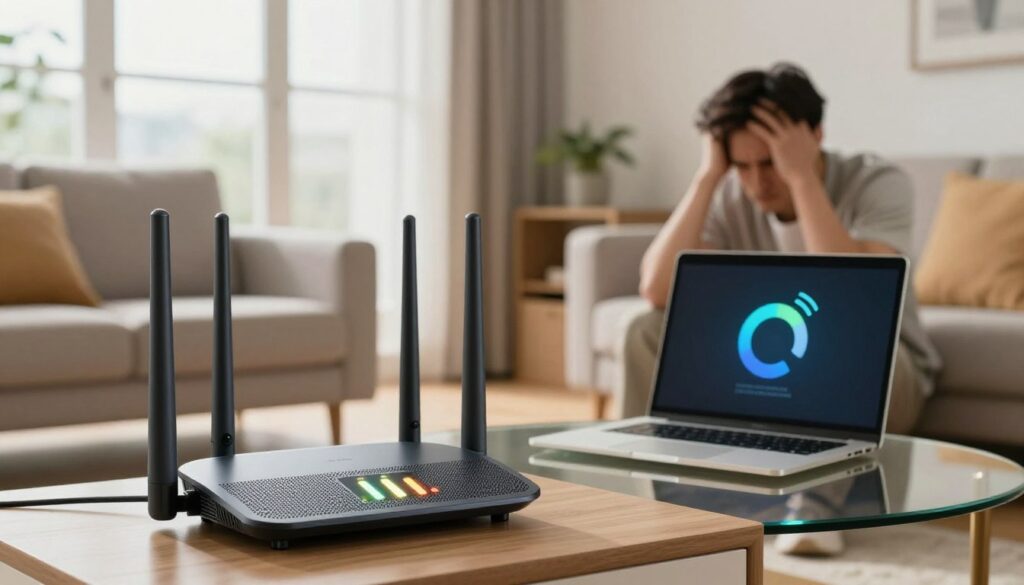
Seeing full bars while pages stall is frustrating. Many US households face this issue and want clear steps to fix it. This guide acts as a practical troubleshooting map for modern cable, fiber, DSL, and mesh setups.

The key idea: the bars on your device show the wireless link to a router or node, not overall internet quality. A strong signal to the router does not guarantee fast speeds from your service provider.
Most bottlenecks fall into three places: your device, the home network, or the ISP. Quick checks often reveal which one is at fault.
“Slow internet” means slow loading, buffering, or lag during calls and games. These can happen even when the signal icon looks perfect.
We’ll start with simple tests, then isolate modem versus router versus wireless issues, look at congestion and interference, check mesh setups and cables, and finally examine ISP-related reasons. Follow the steps to find the root cause and restore reliable connection.
Key Takeaways
- A strong device signal does not equal fast internet from your ISP.
- Quick tests can isolate whether the device, network, or provider is the issue.
- Common causes include congestion, interference, mesh setup quirks, and bad cables.
- “Slow” refers to buffering, long page loads, and lag during interactive use.
- This guide focuses on current US home setups: cable, fiber, DSL, and mesh systems.
Why full Wi‑Fi bars don’t always mean fast internet
Your gadget’s signal meter only reports the radio link to the local node, not the path beyond it. This means a strong device-to-router reading can exist even if the modem or ISP upstream has issues.
What Else Would You Like to Know?
Choose below:
What the signal meter measures: It shows radio signal strength between your device and the router or mesh node. It does not measure the provider’s backhaul, DNS health, or modem status. A healthy local link can hide problems with the internet connection.
Connected without internet vs. connected but slow
- Connected without internet: Local devices talk to each other, but sites and services outside your home won’t load. This often points to modem, ISP, or DNS failures.
- Connected but slow: You can access the web, yet performance is poor. Typical causes include congestion, interference, or device limits.
Common clues to find where the problem lives:
- Multiple devices affected and peak-hour patterns suggest ISP or congestion issues.
- Only one device struggling usually indicates a device-level or software problem.
- Quick modem-level speed tests that fail often implicate the provider.
Before swapping gear or calling support, identify whether the slowdown is local or upstream. That saves time and points you to the right troubleshooting steps.
| Symptom | Likely area | Quick check | Common fixes |
|---|---|---|---|
| Strong signal, pages won’t load | Modem / ISP / DNS | Ping external IP from router or use modem test page | Restart modem, change DNS, contact provider |
| Strong signal, streaming buffers | Congestion / interference / device limit | Test multiple devices; run speed test at different times | Limit background uses, move router, use Ethernet |
| One device slow despite others fine | Device software or hardware | Update OS/drivers, clear apps, try different browser | Reboot device, update drivers, scan for malware |
Quick checks before you change settings
Before you tweak configurations, run a few simple tests that separate local issues from provider problems. These steps take minutes and often point you straight to the cause.
Restart your modem and router the right way
Restart your modem and router the right way
Unplug the modem and router (or gateway) power. Wait 60 seconds. Plug them back in and allow up to 20 minutes for a full reboot.
Why this works: A restart clears temporary glitches, refreshes the connection to the ISP, and resolves IP/DHCP hiccups that block normal traffic.
Run a speed test and compare it to your plan speed
Run a speed test and record download, upload, and ping. Compare results to the “up to” plan listed on your account or bill. If results match the plan, focus on local coverage and device performance rather than the provider.
Use an Ethernet cable to bypass Wi‑Fi and isolate the problem
Plug a device directly to the modem or router with an ethernet cable for one wired test. This separates wireless issues from internet-service problems and is the most accurate check for internet speed.
Test different times of day to spot peak-hour congestion patterns
Run the same tests at different times (morning and evening) for a few days. Peak-hour drops suggest congestion at the provider or neighborhood network.
| Check | What to record | Next step if failing |
|---|---|---|
| Restart sequence | Completed reboot and device responsiveness | Retry speed test; contact provider if persistent |
| Speed test | Download / upload / ping vs. plan | If low, test modem-direct and note times |
| Wired test | Ethernet test result | Focus on router or device if wired is fine |
wifi shows full bars but slow: the fastest ways to pinpoint the bottleneck
A quick, targeted test can reveal whether the bottleneck lives at your modem, your router, or a single device.
Step 1 — test the modem: Unplug or disable the router, then connect one computer by Ethernet to the modem port. Run a speed test and note download, upload, and ping.
If modem-direct speeds are low, the problem is usually upstream — ISP line, neighborhood congestion, or provisioning. In that case, contact your provider.
Step 2 — test the router: Reconnect the router and compare wired and wireless results on the same machine. Large drops on the router or wireless point to router settings, placement, interference, or a bad modem-to-router cable.
“Slow at the modem = call ISP. Fast at the modem but slow at the router = fix router, cables, or Wi‑Fi. Only one device slow = fix that device.”
- Make sure to run tests on multiple devices in the same room to spot a single faulty laptop or phone.
- Use the direct-to-modem test briefly; do not leave your computer exposed without router protections longer than needed.
- If router tests fail while modem tests pass, replace the Ethernet cable and check router firmware before buying new gear.
| Result | Likely action | Why |
|---|---|---|
| Slow at modem | Call ISP / report outage | Upstream line, provisioning, or congestion |
| Fast at modem, slow at router | Check router settings, cables, placement | Router limits, interference, or bad cable |
| Only one device slow | Update drivers / OS, scan for malware | Device hardware or software limits |
Home network congestion and bandwidth overload
When many gadgets and apps run at once, the home network can hit a traffic jam that drags down everyone’s experience. Background tasks often cause this without anyone noticing.
How multiple devices and background activity slow your connection
Cloud backups, OS updates, game downloads, and smart cameras can soak up bandwidth. Two 4K streams, a video call, and a console update can overload many plans and make interactive apps stutter.
Use QoS to prioritize important traffic
Quality of Service (QoS) in your router settings lets you favor Zoom, Teams, gaming, or streaming. Check the router web interface or mobile app to tag traffic or set device priority.
Prune unused devices and stagger heavy tasks
Review the connected network list in the router UI and remove or block devices you no longer use. Idle devices still fetch updates and can consume bandwidth.
Schedule downloads and set up a guest network
Move big downloads and system updates to overnight or off-peak hours to reduce congestion during active times. A guest network can limit visitor bandwidth and isolate their access for better security and steadier speeds.
“Trim background traffic, prioritize urgent apps, and schedule heavy transfers to keep the home internet usable for everyone.”
Strong signal, weak performance: Wi‑Fi interference and router placement
Signals can travel well to one room and still fail to deliver usable internet in another. Small barriers or nearby electronics often turn a strong link into an unreliable connection.
Distance, walls, and building materials
Dense materials like brick, concrete, tile, and mirrors block radio waves and reduce throughput. Even a few thick walls can cut effective range and cause packet loss.
Interference from nearby networks and electronics
Other networks, cordless phones, Bluetooth devices, baby monitors, and microwave ovens create interference that competes for spectrum. That noise lowers real-world speeds and raises latency.
Best way to reposition your router at home
Move the router to a central, elevated spot away from large electronics and metal. A short reposition—just a few feet—often improves strength and coverage.
When to add an extender or upgrade equipment
Consider an extender or modern mesh if dead zones persist, devices drop at distance, or older equipment cannot handle current device counts.
| Issue | Signs | Quick fix |
|---|---|---|
| Material blockage | Good link near router, poor in adjacent rooms | Relocate router; avoid walls with concrete |
| Radio interference | Random dropouts during calls or streaming | Change channel or move electronics away |
| Coverage limits | Consistent low speeds at distance | Add extender or upgrade router |
“Small placement changes often yield the biggest improvements to home internet performance.”
Mesh Wi‑Fi pitfalls: full bars on a satellite unit but slow internet
Even when a satellite node reports excellent local signal, the node’s link back to the main unit can be weak. This creates a misleading view on-device: good local access, poor internet beyond the mesh.
What to check in the app:
- Node online status and whether the satellite is linked to the main unit.
- Backhaul quality indicator (look for low throughput or frequent reconnects).
- Firmware updates and any alert messages the mesh app provides.
Move-test method: Place the satellite beside the main unit to confirm performance. Then move it toward the target area in steps (25% / 50% / 75%) and run short speed tests at each stop. This reveals distance and interference limits.
Best way to fix persistent backhaul problems is an ethernet backhaul. Run an outdoor-rated ethernet cable or hire a pro for a buried line to the satellite node for reliable access and higher throughput.
Special case: metal walls can kill signals. If siding or metal studs block the path, position the node near a window so glass, not metal, carries the link.
| Symptom | Likely cause | Quick fix |
|---|---|---|
| Good local link, no internet | Broken backhaul | Check app, move-test, use ethernet |
| Performance drops at distance | Interference / distance | Reposition, add wired backhaul |
| Signals fail through metal | Metal walls | Window placement or wired run |
Check your hardware: loose or damaged cables and overheating gear
A single faulty cable or overheating device frequently causes intermittent drops and poor throughput. Physical faults often look like provider problems, so inspect the chain from the wall plate to your modem and router.
Ethernet cable checks
Make sure each ethernet cable clicks into the port. Worn retaining clips, kinks, or pinch points behind furniture reduce performance and cause disconnects.
Replace any cable with tears, chew marks, or visible damage. A single bad ethernet cable can wreck the wired test and hide the real issue.
Coax, fiber, and gateway connections
For cable internet, screw the coax on hand-tight to the modem or gateway. Loose coax often creates intermittent drops and weak internet signal.
Fiber jumpers and connectors are fragile. Check for secure seating and avoid sharp bends that stress the fiber and degrade the connection.
Spotting overheating and unstable equipment
Hot-to-the-touch modem or router, frequent reboots, and falling performance under load point to overheating or failing equipment.
- Improve ventilation: keep gear off carpet and avoid stacking devices.
- Move the router/modem to an open shelf and clear vents.
- Update firmware and consider replacement if instability continues.
“A quick physical inspection of cables and clearance around gear often fixes issues faster than complex settings changes.”
Device-level causes: your phone, laptop, or console might be the reason
A single device can make your whole household feel sluggish even when other gear works fine.
How to spot a device-specific problem: If one laptop crawls while other devices stream and browse normally, the issue likely lives in that gadget. Run a speed test on the problematic device and on a newer device in the same spot to compare results.
Update and reboot: Install pending OS updates and update the network adapter driver. Reboot the device to finish installs and refresh the network stack.
Old radios and capped performance
Older wireless standards and aging radios can cap throughput even on a fast plan. If the device predates 802.11ac or has an old adapter, its top speeds will be limited on crowded networks.
Clean up background tasks and check for malware
Close heavy browser tabs, pause cloud sync, and quit large background apps during calls or gaming. Run a reputable antivirus scan—malware can consume bandwidth or change settings and cause persistent issues.
“Compare speeds on two devices in the same room to quantify whether the problem is with the device or the network.”
Quick tip: After updates and a reboot, re-run the test. If the device still lags while others are fine, consider replacing the adapter or the device itself.
Latency problems: when speeds look fine but the internet feels slow
High ping can make a fast plan feel unresponsive during real-time tasks. Measured throughput may read high while responsiveness suffers.
What latency is and why it matters
Latency (ping) is the round-trip time for a packet to travel from your device to a server and back. Even with good download numbers, high latency causes input delay in games and choppy video calls.
How congestion and connection type affect responsiveness
Home network congestion raises ping as queues build when many devices upload or stream. Satellite links add delay due to long distances, while fiber and 5G mmWave usually give lower latency.
Practical steps to reduce lag on your network
- Use ethernet for gaming or work devices to cut variability and lower ping.
- Enable QoS or traffic prioritization on your router to favor calls and games.
- Limit concurrent heavy uploads (backups, large transfers) during meetings or play.
- Measure ping at different times to spot peak-hour congestion and plan around it.
“A stable, low-latency link often matters more for real-time use than headline speeds.”
When the issue is your ISP: outages, provider congestion, and throttling
Not all slowdowns start at home. If many neighbors see drops at the same time, the isp network may be congested. Peak hours often expose limits in the provider’s local nodes and backbone.
How provider network congestion shows up during peak hours
Signs include evening performance drops, large swings in measured speeds, and several households affected together. These patterns point to neighborhood or regional load on the provider.
How to test for throttling with and without a VPN
Run a speed test normally, then repeat using a reputable VPN. If speeds improve markedly with the VPN, throttling of certain traffic is a plausible reason. Record results and times for comparison.
When to contact your ISP and what to ask them to check
- Report outages in your area and request status updates.
- Ask about line signal levels, provisioning, and modem compatibility with your plan.
- Confirm your account is configured for the advertised plan and check for local congestion reports.
Signs it’s time to upgrade your plan or switch providers
If measured speeds match your plan yet household demand exceeds capacity, a higher plan can help. Consider changing provider when peak-hour slowdowns repeat, line faults remain unresolved, or faster access internet options (fiber, fixed wireless) are available locally.
| Symptom | Likely ISP cause | Suggested action |
|---|---|---|
| Evening drops across homes | Provider congestion | Document times, contact isp, ask about upgrades |
| Speeds improve with VPN | Possible throttling | Log tests, ask provider about traffic policies |
| Wired modem test low | Upstream outage or provisioning | Open ticket, request line signal check |
Conclusion
What to take away: A strong signal to your router only confirms a local link, not a healthy internet path across the network. Follow a clear order: restart equipment, run speed tests, then isolate modem vs. router vs. wireless.
Use the simplest proof steps first: an Ethernet test, a modem‑direct wired test, and a multi‑device comparison. These quick checks narrow the cause without changing advanced settings or replacing equipment.
If problems persist after isolation, they usually fall into two buckets: failing or overheating hardware inside the home, or upstream ISP congestion, outages, or throttling. Document speed test results and time‑of‑day patterns. That log helps you fix cables, tune devices, or present clear evidence when you contact your provider.
FAQ
Full Wi‑Fi bars but slow internet — what does the signal meter actually measure?
How can I tell “connected without internet” from “connected but slow”?
What are common signs that the problem is in my home network vs. the ISP?
What should I check quickly before changing settings?
How do I restart my modem and router the right way?
Why should I run a speed test and compare it to my plan?
Why use an Ethernet cable to bypass Wi‑Fi?
Why test at different times of day?
What’s the fastest way to pinpoint whether the modem or router is the bottleneck?
How can I tell if a single device is causing the slowdown?
How do multiple devices and background activity slow my connection?
What does QoS do and should I use it?
How do I prune unused devices from my network?
Why stagger downloads and schedule updates off‑peak?
Should I set up a guest network to limit visitor bandwidth?
How do distance, walls, and materials affect performance even with strong signal bars?
What household electronics cause interference?
Where’s the best place to put my router for coverage?
When should I add an extender or upgrade equipment?
Why can a mesh satellite show full bars but still be slow?
How do I verify a mesh satellite is properly synced to the main unit?
What is the move‑test method for mesh placement?
Is Ethernet backhaul to a mesh unit worth it?
Why do metal walls or window placement affect mesh performance?
What cable issues can degrade performance?
Can coaxial or fiber connections cause signal loss?
How does overheating affect router or modem stability?
Could my phone, laptop, or console be the cause?
How do old Wi‑Fi standards limit my speed?
Can browser tabs, background apps, or malware impact performance?
What is latency and why does it matter if speeds look fine?
What causes high ping on home networks?
How can I reduce lag on my home network?
How does ISP congestion show up and when is it likely the cause?
How can I test whether my ISP is throttling traffic?
When should I contact my ISP and what should I ask them to check?
What signs mean it’s time to upgrade my plan or switch providers?
Why Wi-Fi Gets Slow During Video Calls and How to Fix It Fast
» See exclusive tips for your home