Wi-Fi Is Slow on One Device Only: How to Diagnose It
Diagnose wifi slow on one device with our troubleshooting tips. Get your device connected at optimal speed.
Define the issue: If your internet feels reduced on a single computer or phone while other gear on the same home network works fine, the cause usually lives in that unit, a band or interference mismatch, or a router rule that treats it differently.
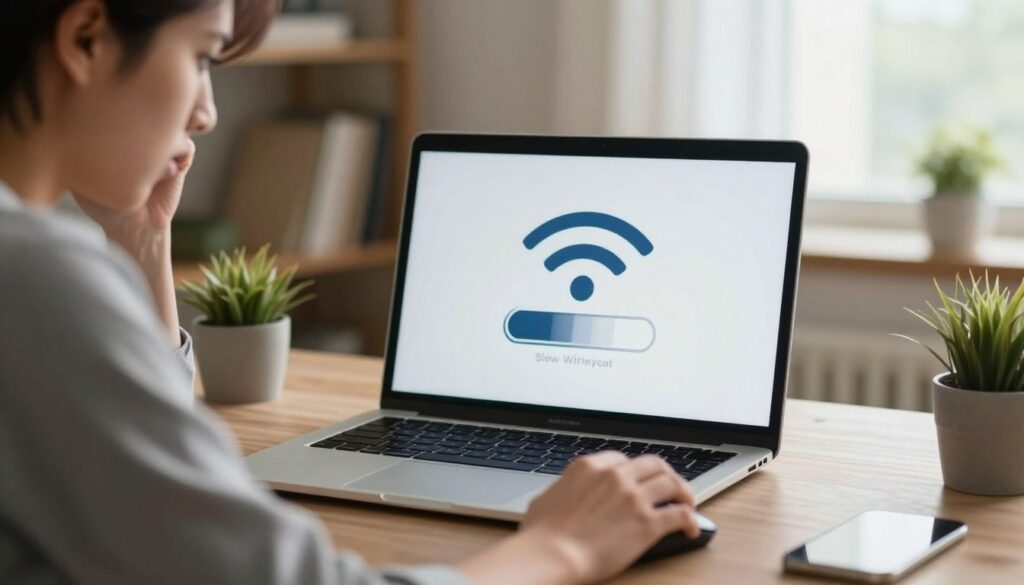
Set expectations: Separate download speed, upload speed, and responsiveness so you chase the right fix. Run a Speedtest to get a clear baseline for internet performance and to spot where the problem sits.
Quick checks save time: compare results across rooms and other machines before changing settings. Confirm whether the issue follows the device or stays tied to a location. This helps focus troubleshooting steps and rules out weak signal areas.
Throughout this guide we follow a simple flow: verify scope → apply fast resets → test bands and metrics → check signal and router configuration → inspect adapter drivers and the OS → rule out apps or malware → reset the network stack as a last resort. The goal is to restore steady internet speeds and a stable connection for video calls, streaming, downloads, and gaming.
Key Takeaways
- Start by defining the scope: device vs. location.
- Use Speedtest to set a performance baseline.
- Test bands, signal, and router settings before deep fixes.
- Check adapter drivers and OS power options for Windows 11.
- Work methodically to restore reliable internet and connection quality.
- Keep questions focused: is the fault with hardware, software, or the network?
Confirm the slowdown is truly limited to one device
Start by proving the problem affects only that particular gadget, not the whole household connection. A quick, fair test will show whether this is a network-wide issue or something local to the unit.
Compare speeds in the same room
Place two devices side-by-side — for example a work laptop and a phone — using the same SSID and distance from the router. Run the Speedtest app or web test on both with the same method.
What Else Would You Like to Know?
Choose below:
Do 2–3 runs and use the median results. Single readings may swing from background traffic or momentary congestion.
Run tests around the home to spot coverage issues
Carry the affected unit to multiple spots: near the router, your usual workspace, and a far room. Note whether performance follows the unit or the location.
“If every system slows in a particular room, the culprit is coverage or interference, not the single gadget.”
Interpret outcomes: if both systems show poor speeds in the same spot, suspect the router or internet link. If only one unit runs poorly, focus on its adapter, settings, or software.
- Document locations and results (kitchen, bedroom, office) to guide later router placement or channel changes.
- If possible, test a wired connection first to confirm the main internet link is healthy before deeper troubleshooting.
Quick fixes that often restore normal Wi‑Fi speeds
Start with simple reboots—most connection headaches clear after a full restart.
Restart the affected device and clear temporary load
Do a full restart of the affected device (not sleep/wake). This clears stuck processes and heavy browser tabs that hog bandwidth.
Before you retest: close video calls, pause cloud sync, and shut unused apps. Then run the same Speedtest from Section 2 to compare results.
Power‑cycle modem and router to eliminate common glitches
Follow this exact step sequence:
- Unplug modem and router power.
- Wait 60 seconds.
- Plug modem back in first, then router.
- Wait until lights stabilize — some gear can take up to 20 minutes.
This clears routing/NAT table errors, refreshes the WAN link, and forces the device to renew its local connection.
“If only one unit improves briefly and then degrades, the pattern often points to drivers, power management, or band selection.”
| Action | Expected result | When to continue |
|---|---|---|
| Full computer restart | Clears background load; quick improvement | If speed improves, monitor for recurrence |
| Modem + router power-cycle | Resets WAN link and routing tables | Retry tests in same location after reboot |
| Close heavy apps/tabs | Frees bandwidth immediately | If problem returns, proceed to adapter checks |
Diagnose wifi slow on one device with targeted checks
Start targeted checks by isolating three metrics: throughput (Mbps), latency (ping), and jitter.
Test both bands if your router supports dual‑band. Connect the affected unit deliberately to the 5 GHz network and run the same Speedtest in the same room. Then switch back to the 2.4 GHz SSID and repeat.
How to tell which band you’re using
Look for separate SSID names like “HomeWiFi” and “HomeWiFi-5G” or check the network details in the OS. Compare results from the same spot to avoid skewed readings.
What congestion and timing problems look like
Congestion shows as wide speed swings, pages that sometimes load fast and sometimes stall, and worse performance at busy hours — often on 2.4 GHz.
Reality check: Mbps affects downloads and streaming quality, but high ping harms responsiveness for gaming and video calls. Jitter measures timing instability and explains choppy audio even when average speed looks fine.
If switching to 5 GHz fixes the issue, focus later steps on interference, channel choice, and placement. If both bands are poor only for the affected unit, look next at adapter settings, drivers, and background apps.
Wi‑Fi signal, interference, and router settings that impact only one device
Small local factors often cause a lone failure in network performance. Start by checking obvious interference sources near the affected unit, such as microwaves, cordless phone bases, baby monitors, or heavy Bluetooth clusters. Move the unit a few feet or switch the appliance off briefly to see if the signal and speeds improve.
Check local interference
Quick experiment: rotate or relocate the gadget. If performance improves, an appliance or a dense Bluetooth group is likely the culprit.
Map weak spots around the house
Run a short Speedtest in each room where the unit is used. Note signal bars and repeatable dips. Mark problem spots on a simple sketch to guide router moves.
Optimize router placement and channels
Place the router centrally and elevated, away from thick walls and metal. For crowded 2.4 GHz airspace, try channels 1, 6, or 11. Use a Wi‑Fi analyzer to pick a less congested channel.
Protect bandwidth with QoS
If many people stream or download, enable QoS or device prioritization in router settings. Prioritize the affected device or work traffic to keep a steady connection during busy hours.
“Small moves and a channel swap often restore reliable signal where complex fixes fail.”
| Action | When to try | Expected result |
|---|---|---|
| Move unit a few feet | If interference is suspected | Immediate signal improvement if local appliance caused the issue |
| Map signal with Speedtest | When locations vary | Identifies weak spots for better router placement |
| Change channel (1/6/11) | Crowded 2.4 GHz networks | Reduced congestion and steadier throughput |
| Enable QoS/prioritization | Household bandwidth contention | Protected bandwidth for critical tasks |
Device-side network adapter settings and drivers that can throttle speeds
Many single-unit connection problems trace back to adapter settings or outdated drivers. Start here before swapping hardware or changing the router.
Disable power-saving that may cut the adapter
On Windows 11 open Device Manager > Network adapters. Right-click the Wi‑Fi adapter, choose Properties, then the Power Management tab.
Uncheck “Allow the computer to turn off this device to save power.” This prevents the adapter from downshifting and causing retransmits or stalls that look like poor internet.
Tune advanced adapter options
In the adapter Advanced tab, set Preferred Band to “Prefer 5 GHz” if supported. Lower Roaming Aggressiveness to Medium or Low to stop frequent scans that interrupt speeds.
Driver and system update steps
If performance worsened after a recent update, try a driver rollback first. If no change, update or reinstall using the manufacturer’s package.
- Old drivers: update.
- New driver caused issues: rollback → uninstall → reinstall.
- Keep the OS and system updates current for network stack fixes.
| Action | When to try | Result |
|---|---|---|
| Rollback driver | After recent driver change | Restore prior stability |
| Reinstall driver | Persistent problems | Clean driver state |
| Replace adapter hardware | Performance caps near router | Removes hardware limits |
Hardware reality check: older adapters and standards may cap maximum speeds even if the router and other computers perform better. If a newer computer achieves expected speeds, adapter quality is likely the limiting factor.
Rule out hidden bandwidth drains and software problems
Before swapping hardware, inspect running programs and active downloads that can quietly eat bandwidth. Start local troubleshooting by looking at what the affected unit is doing; many connection complaints trace to background activity.
Spot and stop background drains
Open Task Manager and check the Processes tab for apps using the network or CPU. Use the Startup tab to disable nonessential programs that launch automatically.
Pause cloud backup, game updates, or large downloads, then rerun a speed and latency test. If performance improves, you’ve found a local bandwidth drain.
Scan for malware and run antivirus
Run a full system scan with Windows Security (Microsoft Defender) or a trusted antivirus tool. Malicious software can generate traffic, cause instability, or hide cryptomining that wrecks performance.
Use Windows network reset and isolation tests
On Windows 11 go to Settings > Network & Internet > Advanced network settings > Network reset. This rebuilds connection settings and often fixes stubborn misconfiguration.
For stubborn issues, connect the laptop by Ethernet to the router as a comparison. If wired tests are clean, the problem is likely the wireless adapter or local settings. Also check that Ethernet and coax cables are snug and undamaged; a flaky cable can mimic device-specific problems.
“Pausing background sync and a quick antivirus scan frequently restores normal internet behavior.”
| Action | When to try | Result |
|---|---|---|
| Disable startup apps | After noticing persistent background use | Frees bandwidth and CPU |
| Full antivirus scan | If unexplained traffic appears | Removes malware-related drains |
| Network reset | After other steps fail | Rebuilds settings and often resolves the issue |
Conclusion
Conclude by confirming whether the problem follows the gadget or stays tied to a room. Follow a clear diagnostic flow: verify the scope, apply quick reboots, test bands and metrics, then check router and environment before digging into adapter, driver, or software fixes.
Strong, actionable steps: if changing the band fixes speeds, focus on interference and channels. If both bands are poor only for the affected unit, target adapter settings, drivers, and background apps.
Keep tests consistent: same room, same test server, and multiple runs so results are reliable. As a final check, try a known-good USB adapter to confirm whether the internal adapter limits performance.
If the issue persists after network reset and driver changes, contact the device maker for firmware or hardware help. Stable connection quality — balanced speed, latency, and jitter — is the goal for real-world tasks.
FAQ
How do I confirm the slowdown affects only a single machine?
What quick steps often restore normal connection performance?
How can I tell if the problem is signal strength or the device itself?
Should I test both frequency bands on my router?
How do I check if latency or jitter is causing problems instead of raw download speed?
What local interference should I look for near the affected machine?
How can I evaluate signal strength and find weak spots in my home?
What router placement changes help a single-room problem?
Can changing the router channel reduce congestion that affects only one machine?
How does QoS help a device that performs poorly?
Could power-saving settings on the network adapter be causing throttled throughput?
Which advanced adapter settings should I check?
When should I update, roll back, or reinstall network drivers?
How do OS updates affect wireless performance?
Could older Wi‑Fi standards limit maximum speeds on a single machine?
How do I find hidden bandwidth drains on the problematic machine?
Should I run malware and antivirus scans if a single device has poor performance?
When is a Windows network reset appropriate?
Why Wi-Fi Gets Slower at Night and What You Can Do
» See exclusive tips for your home